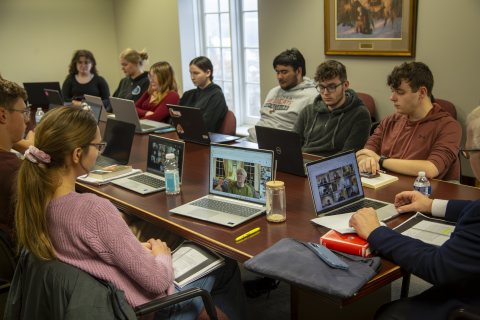
The Rev. Dr. Carolyn J.-B. Hammond, Dean & Fellow of Gonville & Caius College at Cambridge University and Loeb Classical Library editor of the works of St. Augustine of Hippo, met virtually with students in Dr. Lawrence M. Stratton’s Fiat Lux course at Waynesburg University on Thursday, Nov. 20, to lead an in-depth discussion of Augustine’s “Confessions.”
A renowned translator and scholar of early Christian works, Rev. Dr. Hammond is the editor of the Loeb edition of “Confessions,” considered the first spiritual autobiography in Western literature. She recently published a collection of Augustine’s letters to the church, titled “Augustine the Teacher: Teaching Christianity.” She is also the author of “Buried Treasure,” a collection of her articles from “The Church Times,” a weekly Anglican newspaper in the United Kingdom.
Dr. Stratton’s Fiat Lux class, comprised of first-year students, has studied “Confessions” since the beginning of the semester, exploring Augustine’s formative years, intellectual struggles and eventual spiritual conversion. Dr. Stratton emphasized the significance of learning from a leading Augustine scholar.
“After reading and discussing the ‘Confessions’ of Augustine of Hippo, in which he recounts his pilgrimage of faith, with one of the world's leading Augustine scholars and translators, students thus had the remarkable experience of connecting their own spiritual journeys in dialog with one of the great Christian thinkers of all time and his premier interpreter in an intellectual endeavor that they will remember for their lifetimes,” said Dr. Stratton.
Students reflected on how Rev. Dr. Hammond’s insights enriched their understanding.
“From Rev. Dr. Hammond, I learned about the way St. Augustine thinks but also how he honestly answered questions of desire, truth and the restless human heart,” said Avery Rape. “She made Augustine seem like not just a historical figure but someone whose ideas still speak to how we understand ourselves today. Few students get to have direct conversations with a scholar from Cambridge who studies figures like Augustine at such an advanced level.”
Jackson Sauders described the conversation as “a one-of-a-kind experience.”
“It was a pleasure to talk to Rev. Dr. Hammond about her translation of ‘Confessions,’” said Sauders. “She expressed a deep passion for learning about him and the impact he’s had on her.”
Josiah Shimizu said he gained a deeper perspective on the text, recalling Dr. Hammond’s point that “Confessions” is “the first time in history that a person wrote down what it means to be a human being.”
“Augustine shows a picture of what is going on inside his own head, almost like a diary,” said Shimizu. “This creates a deep connection with the author, and you truly feel that you get to know the person and the journey of Augustine. That is why it resonates with Christians and other intellectuals alike.”
Rev. Dr. Hammond explained that her remote class discussion grew out of conversations with Dr. Stratton during his 2024 trip to Downing College in Cambridge.
“We quickly discovered a mutual interest in St. Augustine of Hippo,” she said, which led to her invitation to speak with students.
“It came as an enjoyable surprise when Larry invited me to speak with his students,” said Rev. Dr. Hammond. “I have been translating Augustine for over a decade now and have become familiar enough with the great man to presume to call myself his friend. He inspires me with his honesty and integrity, his thirst for understanding, his sheer love of God.”
Reflecting on Augustine’s conversion narrative, Rev. Dr. Hammond said the story resonates because readers recognize “a soul hungry and thirsty for God, desperate to be done with the past.” She also affirmed Augustine’s lasting influence, adding that he “reflected on fundamental questions of morality and meaning in ways which still speak to us – more than seventeen centuries later.”
###