In recognition of Veterans Day, Waynesburg University honors the legacy of its alumni who have served the nation and reaffirms its commitment to supporting today’s veterans.
Military-affiliated and veteran students bring valuable experiences and perspectives to our campus, and we deeply value and appreciate the service and sacrifices made by them and their families."
Waynesburg’s legacy of military service is reflected in its distinguished alumni whose service extended from the battlefield to the highest levels of public office. James Jackson Purman, a member of the Class of 1864, received the Medal of Honor for his gallantry at the Battle of Gettysburg. Edward Martin, a 1901 graduate, served as a decorated Army general before becoming governor of Pennsylvania and a U.S. senator.
Today, the University continues this tradition of service through its Veteran and Military-Affiliated Center, located at the heart of campus on the first floor of Miller Hall. The center provides dedicated programs and services, assistance navigating military benefits and resources, and a welcoming gathering space for veteran and military-affiliated students. It also offers opportunities to explore the University’s longstanding connection to service in the armed forces.
“Military-affiliated and veteran students bring valuable experiences and perspectives to our campus, and we deeply value and appreciate the service and sacrifices made by them and their families,” said Jeremy Rohanna, Director of Veteran and Military Student Services at Waynesburg University. “As an institution, we are committed to understanding their unique needs, removing barriers and ensuring they have the resources, support and sense of belonging they need to succeed.”
The University further supports those who have served through its Saluting Faithful Service Scholarship. This renewable $500 scholarship is available to active-duty military personnel, members of the National Guard and Reserves, and veterans with an honorable discharge. One scholarship is awarded each fall and spring semester and may be applied toward enrollment in the University’s Online Degree Completion Program or undergraduate or graduate coursework.
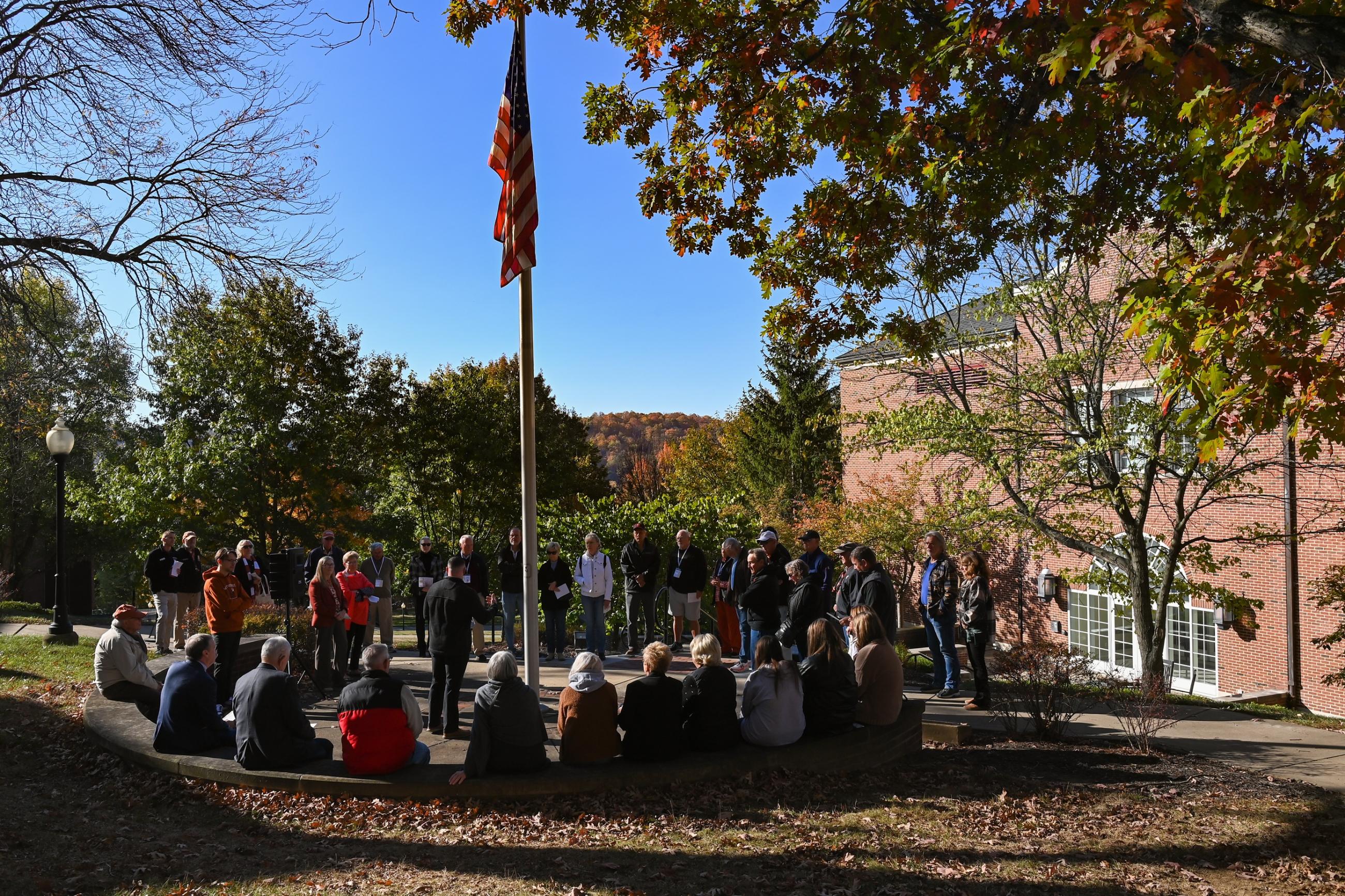
Beyond its programs and resources, the University provides a place on campus to remember and honor the sacrifices of those who have served the nation. The Veterans Memorial Plaza, a gift from the Class of 1950 located in front of Eberly Library, provides students a place to reflect. A plaque, which adjoins the plaza, is inscribed with John 15:13, "Greater love has no one than this, that one lay down his life for his friends."
More recently, in 2024, memorial bricks bearing the names of veterans were added to the plaza, donated by and in honor of alumni, family and friends, as a part of the University’s 175 Years of Light Fundraising Initiative.
James Jackson Purman
James Jackson Purman was known by many titles: lieutenant, principal, lawyer, physician and medical director of the Grand Army of the Republic. But of these things, what Purman is most remembered for is his gallantry during the Battle of Gettysburg, for which he received the Medal of Honor from Congress.
Purman enrolled at Waynesburg College, teaching at a local school to help pay for his tuition. In 1862, just before his senior year, he opted to put his studies on hold to help organize a volunteer Army unit to aid the war raging around him. He was voted 1st Lieutenant of Company A, 140th Pennsylvania Volunteer Infantry and a year later, found himself in the Wheatfield at Gettysburg.
During the second day of battle, Purman was struck near his left ankle after attempting to help a wounded comrade. He laid overnight listening to the cries of dying men around him. The next morning, he was shot in his right leg when opposing pickets exchanged shots. Desperate for water, he called out to the enemy for help. A lieutenant from a Georgia regiment came to his rescue, offered him water and tended to his wounds. The Confederate then got Purman safely off the battlefield by carrying him on his back while crawling on all fours.
Later that night, a Union stretcher party carried Purman to a field hospital. The next day, his left leg was amputated below the knee. The soldier whose life he tried to save had not survived.
In May 1864, Purman was discharged from the Army, and he returned to finish his degree at Waynesburg. He became principal of Baptist Academy, which later became Monongahela College. He also studied law and was admitted to the Greene County Bar. He and his wife then moved to the nation’s capital where Purman pursued a course in a medical school and served as the medical director of the Grand Army of the Republic, a powerful Union veterans’ organization. He also held a position at the U.S. Pension Office.
He kept in contact with the Confederate officer who aided him on the battlefield and, in later years, introduced him to President Theodore Roosevelt, describing the moment when honest compassion held greater weight than opposing opinions.
Edward Martin
When Edward Martin graduated from Waynesburg College, little did the veteran, lawyer and Republican Party politician from Waynesburg, Pa., know, he would go on to serve the country in more ways than he could have ever foreseen.
A newspaper remarked that, “General Martin has a high conception of public duty and obligation to the people. His entire career, either that of a soldier, private citizen or public official has been one which has shown a high degree of courage, of industry, of constructive ability and loyalty. The people generally would have more faith in their Government if we had more men of the type of General Edward Martin.”
Martin offered his loyalty and service during the Spanish-American War in 1898, putting his education on hold and launching the start of his 44-year military career. In 1899, Martin returned to Waynesburg to complete his degree.
After his admittance to the bar in 1905, Martin began practicing law in Waynesburg. He assumed his first of many political offices as secretary of the Greene County Republican Committee that year.
Several years later, he was called back to serve in the First World War where he took the position of lieutenant colonel. After the war, he was awarded the Distinguished Service Cross and the Purple Heart.
Throughout his life, Martin served in several Pennsylvania state political positions including auditor general of Pennsylvania, burgess of East Waynesburg, solicitor of Greene County, state auditor general, state treasurer and governor of Pennsylvania.
On a national level, Martin served as president of the National Guard Association of the United States in 1940 and general of the U.S. National Guard. He also served as president of the Council of State Governments in 1946, which led to his election as a Republican to the U.S. Senate in 1947 where he served two terms, choosing not to seek re-nomination for a third in 1958.
Prior to his death in 1967, Martin was presented with the Distinguished Service Medal and published “Always Be On Time: An Autobiography.” In it, he recalled, starting with Theodore Roosevelt, he had dined with every president since that time.
About Waynesburg U.
Consistently ranked a best value school, Waynesburg University’s Strategy for the 21st Century affirms its commitment to developing an entrepreneurial mindset and ethical leadership skills for all students. Rooted in its mission of faith, learning and service, the private, Christian university is located on a traditional campus in the hills of southwestern Pennsylvania.